

Nvidia GeForce RTX 2080 Founders Edition Review: R For Revolution?
At Gamescom 2018, Nvidia had announced their revolutionary new GPUs, the 20xx series, under the new tag of RTX, which pretty much replaced the previous GTX serial. Having already tasted a glimpse of the GPUs' performance at Gamescom, I was excited to test things out for myself. Well, Nvidia did provide us with a review unit for the RTX 2080, the GPU sitting comfortably between the affordable RTX 2070 and the flagship RTX 2080 Ti. But with a cost tag of $799 (Rs. 68,500 in Bharat), is the GPU actually that proficient, or should you hold on that kidney of yours for a while? Well, let's discover out, as we review the Nvidia GeForce RTX 2080 Founders Edition:
Nvidia GeForce RTX 2080 Founders Edition Specs
Before we get started with the actual review of the graphics bill of fare, let united states of america get the specs out of the way, shall we? The Nvidia GeForce RTX 2080 Founders Edition features abominable specs, and on newspaper, the GPU stands second to none
| Architecture | Turing |
| CUDA Cores | 2944 |
| Core Clock | 1515MHz |
| Heave Clock | 1800MHz |
| TFLOPs (FMA) | lx TFLOPs (8 Giga Rays) |
| Memory Clock | 14Gbps GDDR6 |
| Memory Passenger vehicle Width | 256-bit |
| VRAM | 8GB |
| TDP | 225W |
What's in the Box
The contents of the package are quite minimal and at that place is not much to talk nigh. There is the RTX 2080 Founders Edition itself, a Display Port to DVI Converter, and a couple of booklets that nobody actually cares most.
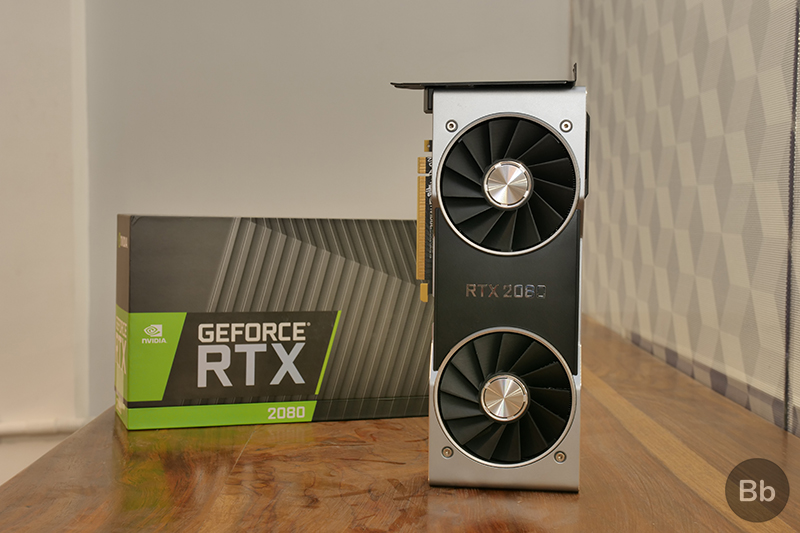
- Nvidia GeForce RTX 2080 Founders Edition
- DisplayPort to DVI Converter
- Quick Start Guide
- Back up Guide
Design and Build Quality
Nvidia's Founders Edition cards have had the aforementioned blueprint linguistic communication for a couple of years now, and quite frankly, I'm pretty impressed. Crafted with premium materials and components, the RTX 2080 is a piece of work of art. The symmetry of the dual-fan setup is amazing, and the RTX branding is subtle, withal powerful.
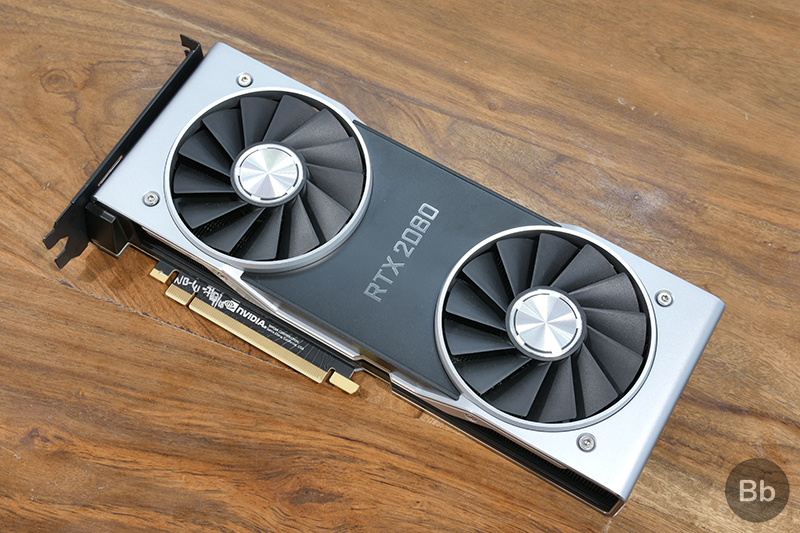
The biggest change has got to exist that dual-fan setup which replaces the unmarried-fan blower organisation found in previous generations. While it certainly looks a lot better, we will exist discussing its impact on the thermal operation later on in this review.
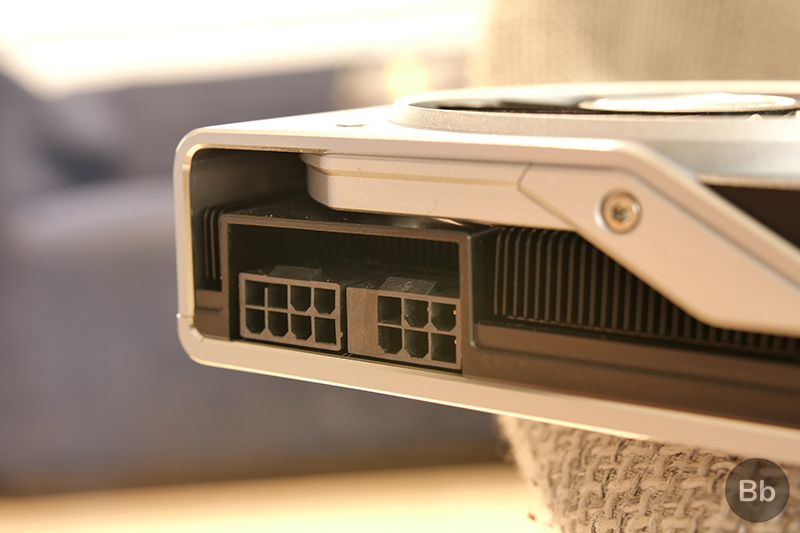
The bottom portion of the GPU consists of the PCI Express x16 pins, while the upper half houses thenext-gen 8-stage power supply along with a GeForce GTX SLI HB bridge port.
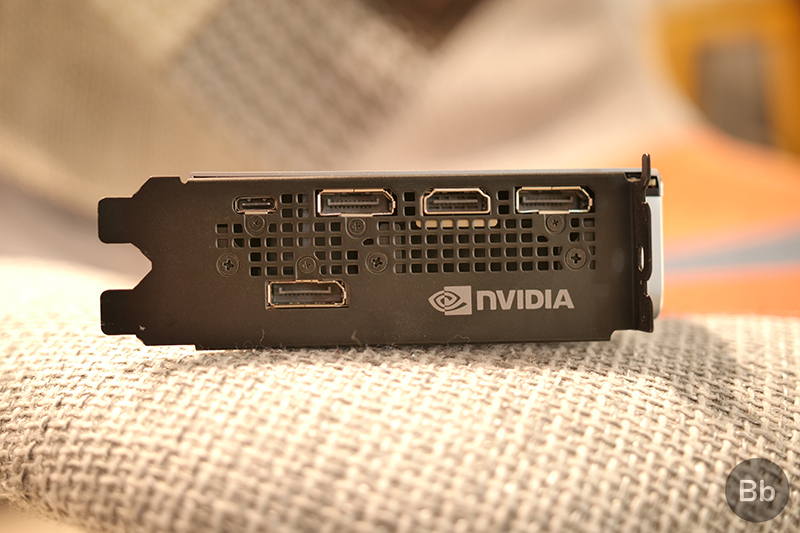
As for the ports, you get 3x Display Port, an HDMI port, and a Type-C port which can be used for VirtualLink. This is followed past the frazzle for the blower fans.
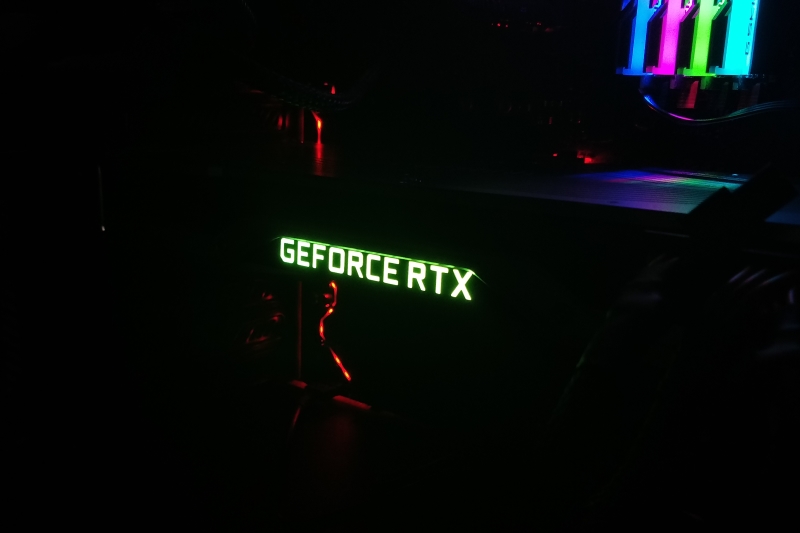
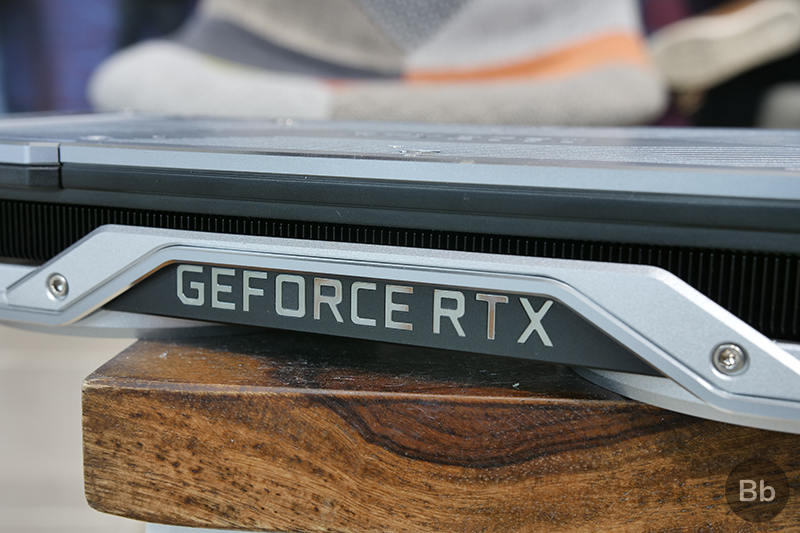
Final just not the least, there is the GeForce RTX logo on the top of the GPU, which looks damn amazing, especially when it lights up in Nvidia's signature green colour.
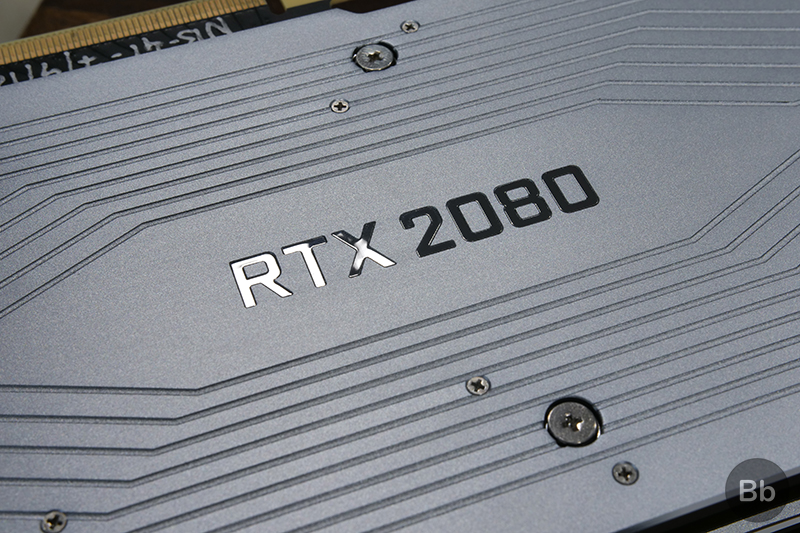
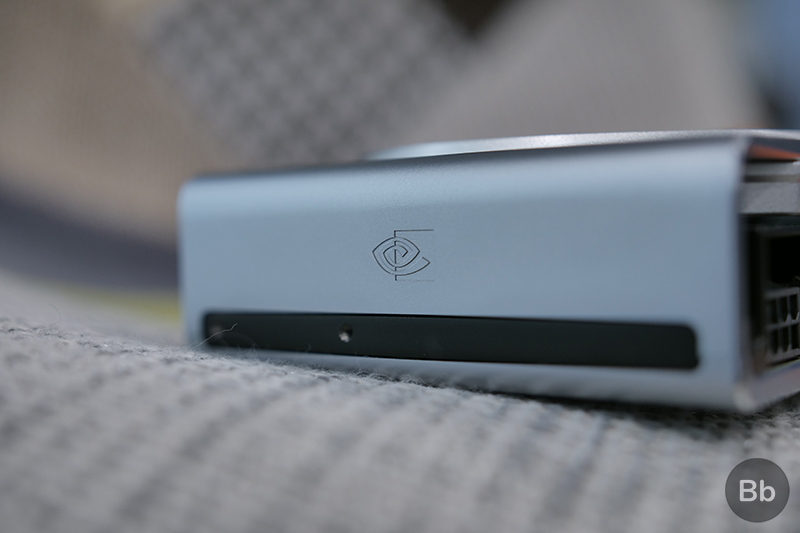
All in all, the build quality of the RTX 2080 is top-notch, the style it has e'er been. The blueprint is where Nvidia has introduced a new change and information technology looks pretty amazing every bit well.
Performance
Based on Nvidia's all-new Turing Architecture, the company claims a 6X performance boost than previous generation GPUs. However, this is just in terms of Ray Tracing, a technology not yet available for gamers to try in games as of this writing. Well, I was pretty much interested in checking out the raw performance of the RTX GPUs, and here are my findings.
To examination the RTX 2080, I installed information technology on my test system which comprised of the Intel i7-8700K processor coupled with 32GB of DDR4-3200MHz RAM. All benchmarks were run with the Os loaded on a 120GB SSD while the games were loaded on a 2TB 7200RPM HDD.
In all of my tests, I ran the games at 1920×1080 resolution and maxed out graphics quality, running settings labeled as Very High, Ultra, Extreme etc.
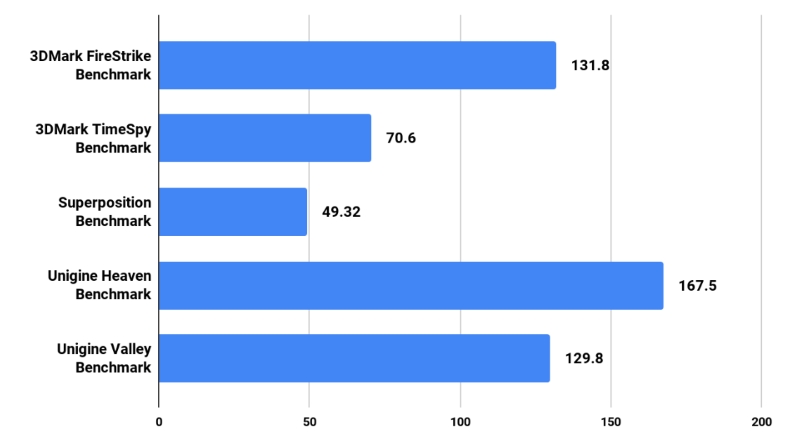

As yous can see, RTX 2080 handles benchmarks quite well. It blazes by the 3DMark FireStrike Criterion, which is pretty much the manufacture standard for DirectX12 Gaming. Fifty-fifty in all other benchmarks, the RTX 2080 manages to shell other GPUs out there quite easily. As for gaming, the GPU oozes by through previous flagships like The Witcher three and manages a score of 109 in even so the industry standard, that is Metro Redux. In all the other games, the GPU maintains a score above 100FPS, while just falling curt of that marker in Hunt Showdown.
Just for reference, in my before review of the GeForce GTX 1080 Ti, the GPU had managed to pull off 122 FPS in the 3DMark FireStrike Criterion, which is something that the RTX 2080 manages to beat hands. Nonetheless, it is worth pointing out that both the tests were performed on different test benches. If y'all are wondering how much of a difference the RTX 2080 brings over 1080 Ti, nosotros volition have a detailed commodity on the aforementioned, so stay tuned.
It is no dubiety that the GPU would perform very well in 4K resolutions also, but since that resolution is restricted to 60FPS only, I had decided to perform my reviews on the 1080p display only, to see the maximum performance that the RTX 2080 could trounce out. Yous can cheque out a detailed criterion review of the RTX 2080 here.
Ray Tracing and DLSS
The major advantage of the new RTX GPUs is the addition of Ray Tracing. Unfortunately, the feature volition not be usable in games until the time Microsoft launches the RS5 update which is said to bring forth the DirectX for Ray Tracing (DTR) back up. Equally for DLSS, the feature is said to work only on 4K systems, and that too requires the same update from Microsoft. However, Nvidia did provide the states with a demo of Epic Games' Infiltrator, and here'due south the basic deviation that DLSS provides:
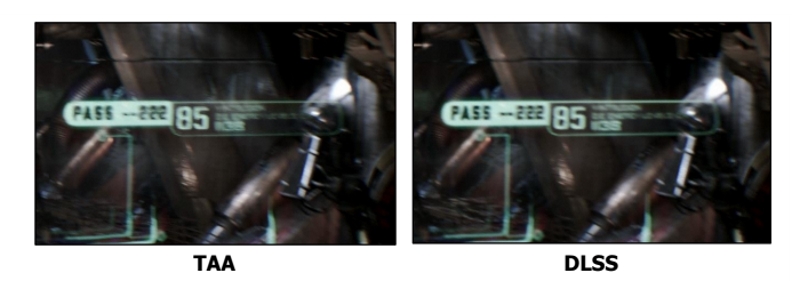
Every bit you can encounter, the divergence is at that place, but DLSS doesn't really bring a massive modify to the overall feel, especially if you're not gaming at 4K resolutions. At present, I know, the flagship serial is meant for 4K, but there are yet plenty of people out at that place, including me, who value higher frames at 1080p more than 4K, and for them, DLSS won't make a difference to be very honest.
Thermals
Ah, the thermals. Truth be told, Nvidia'southward GPUs take e'er been the all-time, but their thermal management in the Founders Edition cards has been disappointing, every bit compared to their AIB ports. However, with the new RTX series, Nvidia has let go of their single fan organisation and has adopted a dual-fan system. As a critic, my favorite part of a review has got to be the section where I am able to highlight all the negativity in a production. And it is in that respect that I detest the RTX 2080, simply because it leaves pretty much nothing to complain virtually.
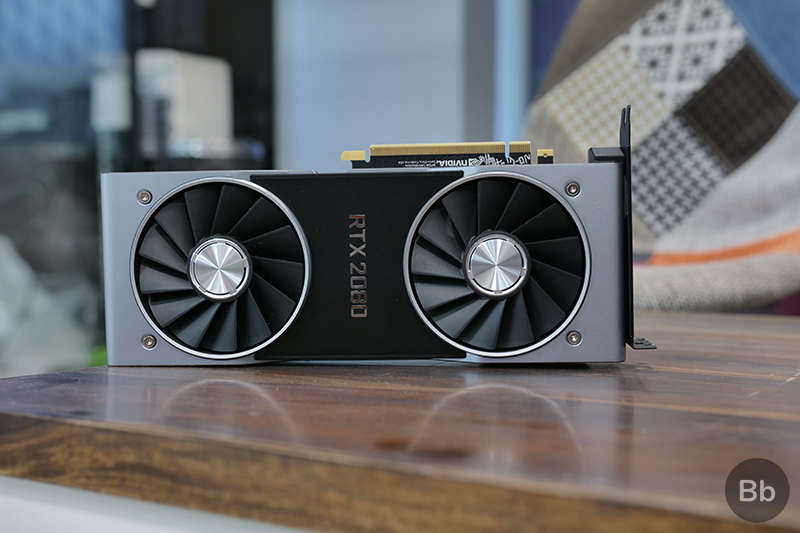
According to Nvidia, the RTX 2080 uses a "dual-axial xiii-blade fans coupled with a new vapor bedchamber for ultra-cool and repose performance." If you lot don't quite understand what that means, simply understand that it houses a dual-fan arrangement, and the performance, well, is pretty damn good. When nosotros talk of gaming or benchmarking, or even stress testing, the lx-lxxx degree Celsius region is said to be the standard. In my testing, the RTX 2080 stayed under 62-degrees after 30 minutes of rigorous stress testing with synthetic benchmarks.
I wanted to test this GPU even more, so I played Shadow of the Tomb Raider, on the about graphics demanding games out there for over 4 hours continuously. And surprisingly, the maximum temperature that I managed was just 77-degrees which is just amazing. Honestly, the RTX 2080 manages to handle heavy loads very well while keeping the temperatures quite low. The all-time function is that the GPU actually supports overclocking up to ane.8GHz out-of-the-box, and considering how well the thermal direction is at the base frequencies, I wait the GPU to keep things absurd even at college frequencies.
Pricing and Availability
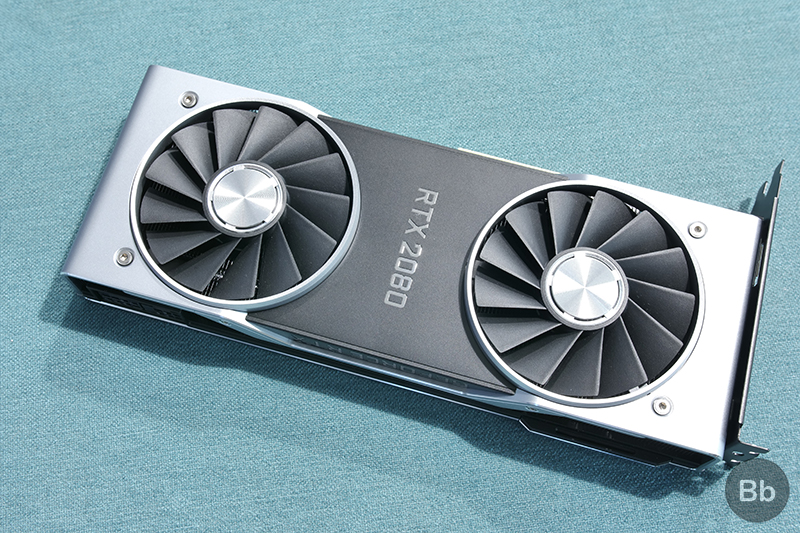
The Nvidia GeForce RTX 2080 is priced at $799 in the U.s.a.. While that does translate to Rs. 58,000 roughly, Nvidia's official price for the RTX 2080 in India is Rs. 68,500. As such, you lot will have to trounce out a premium of Rs. x,500 for the aforementioned GPU. I mean, information technology'due south non as bad every bit how Apple prices its devices, but a premium of 10.5K is pretty steep. The GeForce RTX is upwards for pre-society with shipping estimated at 27th September. However, considering the massive price tag, one must wonder, if the Nvidia RTX 2080 is worth information technology or non?
Nvidia GeForce RTX 2080: Worth It?
At this point of time, many of you must be wondering if the RTX 2080 is worth your money or not? There's no denying the fact that information technology'southward just a couple of weeks until the GTX 1080 and the GTX 1080 Ti see their prices drop, making them just a little bit more affordable. As such, which GPU should y'all go for? Well, if you're someone planning to use the GPU for gaming and desire it to be a long-term purchase, the RTX 2080 is the one for yous. However, if you're looking for value for money, the GTX 1080 Ti will practically make more sense, since it offers nearly the aforementioned performance, at to the lowest degree in 1080p.
The truth is, leaving the factor of Ray Tracing away, the RTX 2080 does non bring a lot more to the tabular array every bit compared to the GTX 1080 Ti. Despite beingness a revolutionary modify in the gaming world, Ray Tracing is even so in its infancy, and it will take at least a year for the technology to exist adopted by both developers and gamers alike. As such, if you lot're planning to buy a GPU right now, personally I'd pick the GTX 1080 Ti once the prices drop.
Simply to make things clear, the RTX 2080 is in no way a bad option, simply once you lot remove the factor of Ray Tracing from it, information technology does seem overpriced every bit compared to the GTX 1080 Ti.
Pros:
- Not bad Design and Build Quality
- Breathtaking Operation
- Out-of-the-box Overclocking
- Superb Thermal Management
Cons:
- Will exist deemed overpriced until Ray Tracing is properly adopted and implemented
Buy Nvidia GeForce RTX 2080 Founders Edition: ($799, Available in India for Rs. 68,500)
Nvidia GeForce RTX 2080 Founders Edition Review: Ray Tracing Revolution!
Ray Tracing is amazing. Having experienced it at Gamescom 2018, I know it. Sadly, there's non much for me to show for it, apart from the same old footages that Nvidia has already pushed out. Which pretty much establishes my betoken. As a GPU, the RTX 2080 is a fantastic GPU, which does offering better functioning than the GTX 1080 Ti and an even better thermal management system which keeps the card cool under the heaviest of loads. Notwithstanding, that's not the highlight of the GPU. The highlight of it is Ray Tracing, the revolutionary technology that should make the lighting conditions in gaming super-piece of cake. Sadly, information technology'due south still in its infancy, with developers still trying to fully understand how to make the most of information technology. As such, until and unless developers have rolled out full support for games along with Microsoft supporting the engineering, it is best for consumers to look out purchasing the RTX 2080.
| REVIEW OVERVIEW | |
| Pattern and Build Quality 9.5 | |
| Performance ten | |
| Thermals 9.5 | |
| Value for Money eight | |
| SUMMARY The Nvidia GeForce RTX 2080 is a heck of a GPU, which offers pretty much the best performance, whether it's on 1080p, 1440p, or 4K. All the same, once y'all remove the factor of Ray Tracing from the GPU, it is only an incremental update over the GTX 1080 Ti, which kind of reduces its value for money, because that Ray Tracing isn't completely ready yet. | 9.3 OVERALL SCORE |

Source: https://beebom.com/nvidia-geforce-rtx-2080-founders-edition-review/
Posted by: wilcoxongage1946.blogspot.com
0 Response to "Nvidia GeForce RTX 2080 Founders Edition Review: R For Revolution?"
Post a Comment